Teodoro Says Towing the Sierra Madre Would Be an “Act of War”
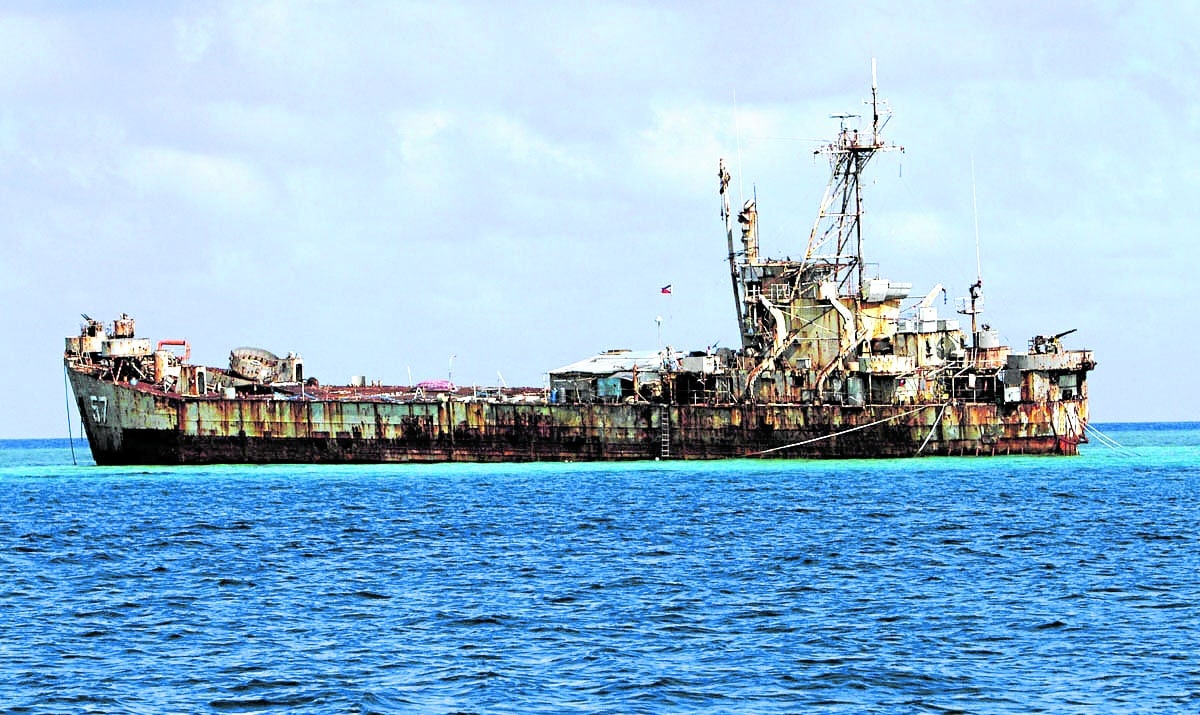
Defense Secretary Gilberto “Gibo” Teodoro Jr. warned on Friday that any attempt by China to forcibly tow the grounded BRP Sierra Madre away would amount to an “act of war” against the Philippines.
His remarks came in response to a report by a Chinese-language newspaper based in Manila. The paper said Beijing was weighing the removal of the warship from Ayungin (Second Thomas) Shoal as one of 10 possible “countermeasures” against Manila, amid deteriorating ties over the maritime dispute.
“Any threat against BRP Sierra Madre will be taken very seriously because it will be an act against a military vessel of the Republic of the Philippines,” Teodoro said in an online interview with reporters.
A deliberate outpost
The vessel, now rusted and in poor condition, was run aground on purpose at Ayungin in 1999 to serve as a military outpost in the West Philippine Sea. That was four years after China seized Panganiban (Mischief) Reef. Both features lie within the Philippines’ exclusive economic zone.
Teodoro stressed that even an attempt against the World War II-era ship, or any incident involving the use of force, would still qualify as an “act of war.”
Possible measures on the table
One of the other reported options is cutting off the resupply of troops stationed aboard the Sierra Madre. Those personnel depend on sea deliveries of fuel, food, water, medicine and other essentials. According to the report, China would “take strong measures” to block any Philippine attempt to forcibly break through its blockade.
The Chinese Commercial News said the 10 measures were laid out in its Friday report, but it noted that Beijing had not officially confirmed that these “potential options” were under consideration or had been approved.
The paper cited “well-informed sources” who said Beijing was “gradually losing patience” with recent Philippine actions and statements. That appeared to refer to heated exchanges between Philippine officials and Chinese Ambassador Jing Quan and his embassy over the dispute.
Among the proposed steps are:
- Barring “anti-China” Filipino politicians and their immediate families from entering China, freezing their assets there, and banning Chinese companies from doing business with them.
- Publicly disclosing their commercial and financial dealings with China.
- Restricting Chinese citizens from traveling to the Philippines.
- Tightening labor rules for Filipino workers in Hong Kong and Macau.
- Arresting more Filipinos working illegally in China.
- Closing certain Chinese consulates, including the one in Hong Kong, should Manila approve an additional Taiwan office in Cebu.
- Cutting off fuel and fertilizer supplies and limiting exports of essential goods to the Philippines.
Act of war versus state of war
Teodoro clarified that an offensive act against a Philippine warship should not be mistaken for a “state of war.”
“It’s not a state of war … but an act of war because it is an offensive act against a Philippine warship,” he said. Only the President and Congress have the authority to declare a state of war. Under the Constitution, Congress must approve such a declaration by a two-thirds vote of both chambers sitting in joint session, voting separately.
The Mutual Defense Treaty question
When asked whether a Chinese attempt to board the Sierra Madre could activate the Mutual Defense Treaty (MDT) with the United States, Teodoro said that possibility was on the table. However, he added that the final call would rest with President Marcos.
He was careful to say such an incident could lead to invoking the 1951 treaty, not that it would necessarily do so. The pact obliges both countries to respond to an armed attack on either one in the Pacific, in line with their own constitutional procedures.
Several US officials, including the secretaries of state and defense, along with American diplomats, have said Washington’s commitments under the treaty are “ironclad.” The US has also stated that the pact covers armed attacks on Philippine armed forces, public vessels and aircraft, including those of the Philippine Coast Guard, anywhere in the South China Sea.
Economic leverage
Asked about the proposed economic sanctions, Teodoro said the Philippines’ reliance on China could be turned against it.
“It just goes to show you that whatever supposed goodwill that they are doing is a weapon and they are weaponizing it,” he said.
He urged both the government and private businesses to strengthen domestic industries and spread out their supply chains, especially for critical infrastructure. “We cannot place complete trust in a country that claims our territory,” he said.
Teodoro also called on companies to source raw materials and finished goods from multiple countries rather than leaning heavily on one. “We are constantly being threatened subtly and now more overtly,” he added.
Military funding and domestic defense industry
Amid the rising tensions, Teodoro again called for an overhaul of the military modernization law. He said the current framework is making it hard to secure enough funding for the Armed Forces of the Philippines. The defense establishment has been “stuck” with the comparatively small P50 billion allocated for military upgrades because of the law, he said, calling the spending system “restrictive and no longer suited to present realities.”
He also pushed for a stronger domestic defense industry, arguing that the country must build basic industries capable of supporting local production of military equipment. He pointed to South Korea and India as models.
Background to the diplomatic row
The latest exchanges began with remarks Jing made on October 15. He was responding to reporters’ questions about Teodoro’s description of China as the “lone troublemaker” in Southeast Asia. Jing dismissed that characterization as “nonsense,” insisting the region was peaceful and that the Philippines was fortunate to have China as a neighbor. He added, however, that China “may easily win” against the Philippines but had chosen not to use force because it was peace-loving.
President Marcos viewed the comments as a threat and as undiplomatic. On Monday, Foreign Secretary Teresa Lazaro summoned Jing to lodge a formal protest. Some Philippine lawmakers also read the remarks as a threat, and several moved to have him declared persona non grata and expelled.
The Chinese embassy responded with a series of social media posts, accusing Filipino politicians with personal political ambitions of undermining bilateral relations. It told lawmakers to “stop bluffing” and declare Jing persona non grata, adding: “Just do it.”